
Buying meat in bulk usually does save money, but the saving is smaller and more conditional than most sellers admit.
Two things decide it: whether the cut mix suits how you actually cook, and whether you have the freezer space to hold it.
This guide shows the real cost per kilo on a bulk pack, explains the yield maths that catches people out, and is honest about when bulk buying is the wrong call.
The Real Cost Per Kilo of a Bulk Meat Pack
The only number that tells you whether a bulk pack is good value is the price divided by the actual packed weight, which on premium Australian beef packs typically lands between $32 and $75 per kilogram depending on the cuts included.
Packs are almost always advertised as a single price, which makes them impossible to compare against a shelf price until you do the division yourself. Here is what that looks like across our own range, so you can see how much the cut mix moves the rate. All figures are AUD and current as at 31 August 2026.
| Pack | Approx. packed weight | Price | Cost per kg | What is in it |
|---|---|---|---|---|
| Family Box | 19.5 kg | $630 | $32/kg | Porterhouse and grass-fed mince |
| Lamb Mince Box | 10 kg | $340 | $34/kg | Australian lamb mince |
| Teys Mixed Steak Box | 11.5 kg | $518 | $45/kg | Porterhouse, scotch, eye fillet |
| Cape Grim Mixed Box | 11.6 kg | $789 | $68/kg | Porterhouse, scotch, eye fillet |
| Southern Ranges Mixed Steak Box | 12 kg | $900 | $75/kg | Porterhouse, scotch, eye fillet |
Notice the spread. A pack built around mince and porterhouse comes in at less than half the rate of one built around three premium steak cuts. Neither is better value in the abstract. The right comparison is against what you would pay for those same cuts, at that same grade, bought separately.
Why Carcass Weight Is Not What Lands in Your Freezer
If you are quoted a price on a half or quarter beef, that price is usually against hanging weight, and only around 60 to 70 per cent of it will reach your freezer as packed meat.
Bone, excess fat and trim all come off between the hanging carcass and the vacuum-sealed pack. A quarter quoted at 80 kg hanging weight might yield somewhere near 50 to 55 kg of usable meat. Work the price per kilo off the hanging figure and the pack looks cheap. Work it off the packed figure and it often looks ordinary.
This is the single biggest reason people feel let down by a bulk order. They compared a hanging-weight rate against a supermarket shelf price, which is a boneless retail price, and the two are not the same measure at all.
Packs sold by packed weight, like the ones in the table above, remove that problem entirely. If a seller quotes hanging weight, ask for the expected packed weight before you compare anything. It is a fair question and any decent supplier will answer it.
How Much Freezer Space Do You Actually Need?

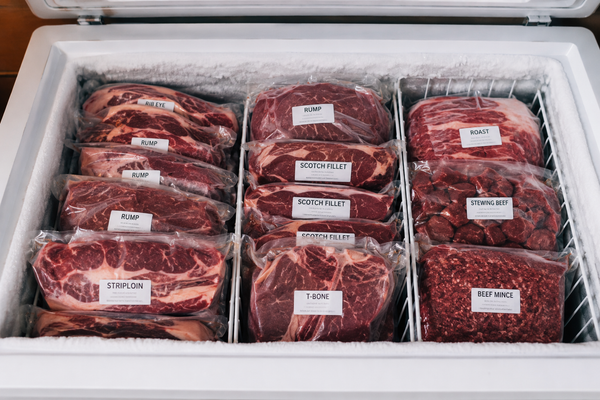
As a planning rule, allow roughly two litres of freezer space per kilogram of vacuum-sealed meat, so a 12 kg pack needs about 25 litres and a 50 kg order needs about 100.
Vacuum-sealed packs stack flat and use space far better than loose containers, which is part of why bulk orders arrive sealed rather than boxed loose. Even so, freezer capacity is the constraint that quietly kills most bulk purchases.
Sizing your freezer to your order
The freezer drawer under a standard fridge holds around 80 to 120 litres, most of which is already in use. A 200 litre chest freezer comfortably takes a 50 kg order with room to rotate stock. Below that, stick to single packs of 10 to 20 kg.
If the meat will not fit, the saving is theoretical. Buy the pack size your freezer can actually hold, and buy again in three months rather than stretching to a larger order you have nowhere to put.
Does the Cut Mix Actually Suit You?
A bulk pack only saves you money on the cuts you would have bought anyway, so the ratio of steak to mince to slow-cook cuts matters more than the headline price.
A pack heavy on premium steak suits a household that eats steak two or three nights a week. It is poor value for a household that mostly cooks mince, curries and slow-cooked meals, because the expensive cuts sit in the freezer while the cheap ones run out.
Work backwards from your actual week. Count how many meals are quick-cook steak, how many are mince, and how many are low and slow. Then find the pack whose ratio looks closest to that. Mixed steak boxes suit the first group, while a household leaning on lower cost beef cuts for everyday meals is usually better served by a mince-led pack or by building an order from a budget-friendly beef range.
When Buying Meat in Bulk Is Not Worth It
Bulk buying is a poor decision for small households without a chest freezer, for cooks who only eat one or two specific cuts, and for anyone whose cooking pattern changes week to week.
A single person or a couple eating meat three times a week will take close to a year to work through 20 kg. That is inside the quality window for sealed beef, but only just, and it means a year of freezer space committed to one purchase.
The same applies if you only ever cook eye fillet. Buying a mixed pack to get at one cut means paying for nine kilos of things you did not want. In that case, buy the single cut in the size you need and skip the pack entirely.
Delivery is the other line people forget. On a national order, freight is part of your effective cost per kilo, and a small pack shipped a long way can wipe out the discount completely. Always add it in before you compare.
How to Buy Bulk Meat Online Without Getting Burned
Before ordering, confirm four things: the packed weight, the exact cuts and their individual weights, how the meat is sealed, and the delivery window.
Vague pack descriptions are the warning sign. A seller who will not tell you the weight of each cut is usually padding the pack with mince and sausages. Good listings give you the breakdown, and the better ones name the producer and the grade rather than saying premium.
Check that the meat arrives cryovac sealed. Sealing is what makes a bulk order last long enough to be worth buying, and it is worth reading up on storing cryovaced meat properly before your first order lands. Once it arrives, portion and label everything the same day.
Finally, look at what happens after delivery. Anything you plan to eat that week can go in the fridge, where sealed beef keeps for longer than most people expect, and the rest goes straight into the freezer. If you want the fuller ordering walkthrough, our guide to buying bulk beef covers the process end to end.
Buy Bulk Only When the Maths Works
Buying meat in bulk saves money when the cut mix matches how you cook and the freezer can hold the order. Do the division, check the packed weight, and add freight before you compare. If the maths works for you, start with our grass-fed mixed boxes.