
A full freezer is one of the real advantages of buying meat in bulk, but it only pays off if the meat still eats well six months later.
The short answer to how long can you freeze meat is that it stays safe indefinitely at a steady minus 18C, though its quality runs on a much shorter clock.
This guide sets out Australian freezer times by cut, explains what actually goes wrong first, and shows how to keep a bulk beef order at its best.
How Long Can You Freeze Meat? The Quick Answer by Cut
Vacuum-sealed beef steaks and roasts hold their quality for around 12 to 18 months at minus 18C, home-wrapped cuts for 6 to 12 months, and beef mince for only 3 to 4 months.
The gap between those numbers comes down to one thing: air. Anything that keeps oxygen off the surface of the meat buys you months. The table below is the working reference we use for our own stock, and it assumes a freezer that holds a steady temperature rather than one opened twenty times a day.
| Cut or product | Cryovac sealed | Home wrapped | What goes first |
|---|---|---|---|
| Beef steaks: scotch fillet, porterhouse, rump | 12 to 18 months | 6 to 12 months | Surface colour, then texture |
| Beef roasts and whole primals | 12 to 24 months | 6 to 12 months | Dehydration on exposed fat |
| Brisket and slow-cook cuts | 12 to 18 months | 6 to 9 months | The fat cap dries out |
| Beef mince | 6 to 8 months | 3 to 4 months | Fat oxidises and flavour turns |
| Sausages | 4 to 6 months | 1 to 2 months | Seasoning and fat oxidise |
| Lamb racks, legs and chops | 9 to 12 months | 6 to 9 months | Fat firms and yellows |
| Pork chops and roasts | 6 to 8 months | 4 to 6 months | Soft fat oxidises quickly |
| Offal: liver, kidney, heart | 4 to 6 months | 3 to 4 months | Texture, then flavour |
Beef steaks and roasts
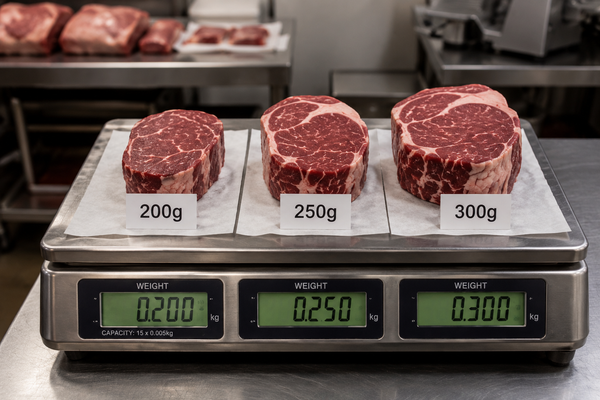
Whole muscles and thick steaks freeze best, since there is less exposed surface relative to the size of the cut. A cryovac-sealed scotch fillet or porterhouse will still cook and eat well at a year. Portion thick rather than thin if you want the longer window.
Mince, sausages and smaller cuts
Mince has an enormous amount of surface area and exposed fat, which is why its window is the shortest of any beef product. Sausages are shorter again, because salt and seasoning speed up fat oxidation. Treat both as things to use within a few months.
Lamb, pork and offal
Lamb sits close to beef, though its fat firms and yellows sooner. Pork has softer fat that oxidises faster, so six months is the sensible working limit. Offal is best used inside four months, while its texture still holds up in the pan.
Safe Forever, Good for Months: The Difference That Matters
Meat held constantly at minus 18C or below stays safe indefinitely, so every storage time you see published is a quality window rather than a safety limit.
That distinction is the most misread thing about freezing. Food safety guidance is clear that freezing at this temperature halts bacterial growth completely, so a steak forgotten at the back of the freezer for two years will not make anyone ill. What changes over time is everything you actually paid for: moisture, colour, tenderness and flavour.
Three processes keep running slowly even at minus 18C. Water migrates out of the muscle and forms ice crystals that puncture cell walls, so the meat gives up more juice when it thaws. Fat oxidises and picks up a stale note, which is why fatty cuts and mince fade first. Surface moisture escapes as vapour and leaves dry, greyish patches behind.
None of that is dangerous. All of it costs eating quality, and on premium beef the eating quality is the entire reason for the purchase, which is also why frozen beef compares so well with fresh when it is handled properly from the start.
Why Packaging Changes Everything

Vacuum sealing roughly doubles the useful freezer life of meat, because it removes the oxygen and the trapped air gap that cause freezer burn and fat oxidation.
Cling film and a freezer bag will always leave air against the surface of the meat. That air holds moisture the meat is steadily losing, and oxygen the fat is steadily reacting with. Over a few months, that combination is what turns a good steak into a dry, flat-tasting one.
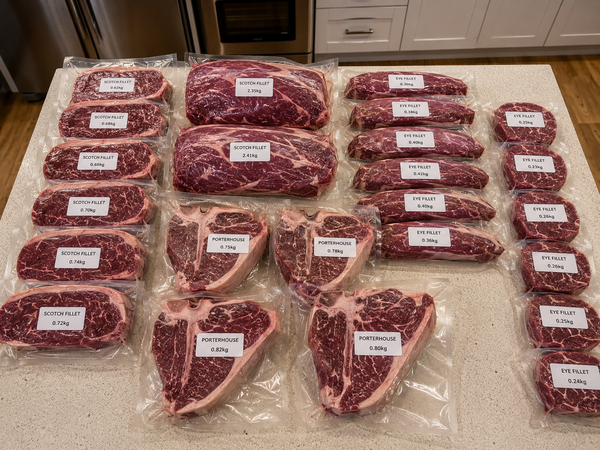
A proper cryovac seal removes both problems at once. It also stops the meat picking up freezer odours and keeps blocks flat and stackable, which matters when a bulk order has to fit into a domestic chest freezer. This is why premium orders are shipped sealed rather than simply wrapped, and it is the main reason vacuum sealing changes how long meat keeps.
If you are re-portioning at home, a vacuum sealer pays for itself quickly on a large order. Failing that, double wrap: cling film hard against the meat with no air pockets, then a freezer bag with the air pressed out.
Freezer Burn: What It Is, How to Spot It, How to Stop It

Freezer burn is dehydration rather than spoilage: moisture leaves the surface of the meat and air takes its place, leaving dry, discoloured patches that taste flat but are completely safe to eat.
It happens whenever meat is exposed to air in the freezer, and it happens faster when the temperature fluctuates. Every time a freezer warms slightly and cools again, a little more moisture is drawn out of the surface. Cheap wrapping and an overfilled, frequently opened freezer are the two biggest causes.
What freezer burn looks like
Look for greyish-white or tan patches, a dry and slightly leathery surface, and heavy ice crystals inside the packaging. On mince it shows as pale, crumbly edges. The meat is still safe, but those areas will be tough and bland.
How to prevent freezer burn
- Vacuum seal, or double wrap with no air pockets against the meat.
- Freeze in portions you will actually use in one go.
- Keep the freezer at minus 18C or colder and avoid overfilling it.
- Freeze fresh, not at the end of a cut's fridge life.
Freezing a Bulk Order: Portioning, Labelling and Rotation

A bulk order should be portioned, sealed and labelled on the day it arrives, because everything that decides how well it keeps is settled in that first hour.
A quarter beef typically gives a household of four somewhere between four and six months of regular eating, which sits comfortably inside the quality window for sealed beef. The risk is not the total time. It is having a few packs pushed to the back and forgotten for two years while the rest turns over.
Work through the order in one session. Break anything oversized into meal-sized portions, keep steaks thick, seal each portion flat, then write the cut and the date on every pack in marker. Load the freezer with the oldest stock on top and work first in, first out from there.
One more habit worth building: keep a short list on the freezer door of what went in and when. On a large order it takes five minutes and it is the difference between using the whole quarter well and throwing out the last of it.
Thawing and Refreezing Without Wrecking the Cut
Thaw meat in the fridge, allowing roughly 24 hours for steaks and up to 48 hours for a large roast, since slow thawing keeps far more moisture in the muscle.
The kitchen bench is the common mistake. It thaws the outside long before the centre and leaves the surface sitting in the temperature range where bacteria multiply. Cold water in a sealed bag is the faster safe option, changed every half hour, but the fridge still gives the better result on a premium cut.
Plan the thaw around when you want to cook. A cryovac-sealed steak moved to the fridge the night before will be ready the following evening, and it will hold well for a day or two after that if you need the flexibility, much like beef stored in the fridge from fresh.
Refreezing is safe if the meat thawed in the fridge and never went above 5C, though you will lose more moisture the second time around. The practical answer is to thaw only what you plan to cook, and there is more detail on refreezing cryovaced meat and on thawing without losing quality if you want the full method.
Freeze Beef That Is Worth Keeping
Frozen meat stays safe indefinitely, so the numbers that matter are quality windows: roughly a year for sealed beef, a few months for mince. Sealing, portion size and a steady temperature are the parts you control. Start with beef worth keeping, and browse our 100% grass-fed and finished beef.