
The wagyu vs angus question is really a question about fat. Wagyu is a Japanese breed group selected over generations for intramuscular fat, while Angus is a British breed selected for consistent eating quality and yield. Both produce excellent Australian beef.
They cook differently, they are priced very differently, and for most everyday meals one of them is clearly the better buy.
Here is how they compare and when each is worth it.
Wagyu vs Angus at a Glance
Wagyu carries far more intramuscular fat, eats softer and richer, and costs considerably more per kilogram, while Angus gives a firmer, beef-forward steak with better everyday value.
| Feature | Wagyu | Angus |
|---|---|---|
| Breed origin | Japan, mainly Japanese Black genetics | Scotland, mainly Black Angus |
| Marbling | Very high, fine and evenly spread | Moderate, coarser pattern |
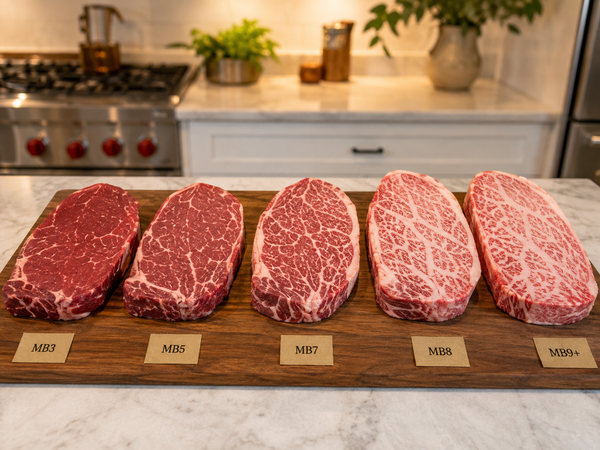
| Typical marble score | MB5 and above, often MB8 to MB9+ | MB1 to MB4 |
| Grading | AUS-MEAT marble score, sometimes Japanese BMS | MSA eating quality grading |
| Texture | Soft, buttery, melts on the palate | Firmer with a satisfying chew |
| Flavour | Rich and sweet, fat-driven | Clean and beefy, mineral notes |
| Portion size | 100 to 150g per person | 250 to 300g per person |
| Price per kg | Significantly higher | Substantially better value |
What Wagyu Actually Is, and Why the Price Varies So Much
Wagyu is not one product but a spectrum, and the biggest driver of price is how much wagyu genetics the animal carries and how long it was fed.
Two steaks can both be labelled wagyu and be very different things. A fullblood animal carries 100 per cent wagyu genetics. A crossbred, usually wagyu over Angus, carries around half. The crossbred still marbles well above standard beef, but it will not reach the marble scores a fullblood does, and it should not be priced as if it will.
Time on feed is the other lever. Australian wagyu programmes commonly run several hundred days on feed, far longer than a grain-fed Angus programme, and that extended feeding is what builds the marbling. It is also the single largest cost in producing the animal, which is why the retail price sits where it does.
Fullblood, purebred and crossbred wagyu
Fullblood is 100 per cent wagyu genetics. Purebred is a high percentage achieved through successive crosses. Crossbred, often sold as F1, is usually half wagyu and half Angus. Ask which one you are buying, because the label alone will not tell you.
What Angus Brings: Consistency, Size and Value
Angus dominates premium Australian retail because it delivers reliable eating quality at a price people will pay every week, with cuts sized for a normal dinner.
Angus marbles well without the extended feeding wagyu requires, and it does so consistently enough that MSA grading can predict eating quality with real accuracy. That consistency is why it underpins so much of the premium beef sold here, and it is what you are buying when you buy Angus rather than unspecified beef.
It also handles a wider range of cooking. Angus stands up to a hot grill, a long smoke and a slow braise. Wagyu is far more limited: outside a few cuts, high heat and long cooking simply waste what you paid for. For a look at where Angus fits across the range, our Angus beef collection covers the main cuts.
Marbling and Grading: Marble Score Against MSA

Marble score rates the amount of intramuscular fat from 0 to 9 or higher, while MSA grading predicts eating quality across the whole production chain, so the two systems answer different questions.
Wagyu is usually sold on marble score because marbling is the point of the product. MB5 is already well above standard beef. MB8 and MB9+ are the heavily marbled steaks people picture when they think of wagyu, and they are meant to be eaten in small portions.
Angus is more often sold on MSA grade, which accounts for breed, feeding, ageing, processing and the specific cut. It is a better predictor of how a steak will actually eat than marbling alone, and it is worth understanding why MSA grading matters before comparing any two products.
Feeding sits underneath both systems. Grain finishing lifts marbling in either breed, which is why grain-fed and grass-fed beef marble differently even within the same cut and grade.
Price and Value: Is Wagyu Worth the Premium?
Wagyu is worth the premium for occasion eating and small rich portions, and it is poor value for everyday meals, large servings, or any cut you plan to cook hard.
The per-kilogram gap is real and large, but the per-serve gap is narrower than it looks. A wagyu steak is usually served at 100 to 150g because the fat content makes larger portions heavy going, while an Angus steak is typically 250 to 300g. On a per-plate basis, the difference closes.
Where wagyu stops making sense is volume. Feeding six people, filling a freezer, or cooking anything low and slow are all jobs Angus does better and cheaper. Buying wagyu for a family barbecue means paying for marbling that a hot grill will largely render away.
The honest position: buy Angus for the weekly rotation, and buy wagyu when the meal itself is the occasion. Our introduction to wagyu beef covers what to expect the first time.
Cooking Them Is Not the Same Job
Wagyu needs lower heat, shorter cooking and smaller portions, while Angus rewards the high heat and longer cooking that would ruin a heavily marbled steak.
Fat renders at a lower temperature in wagyu than in standard beef, so a screaming hot pan drains the steak of the very thing you paid for. Sear it briefly on a moderately hot surface, cook no further than medium rare, rest it, then slice thin and serve less than you think you need.
Angus is far more robust. It takes a hard sear, a reverse sear, a long smoke or a braise without complaint, and a well-marbled Angus scotch fillet is genuinely forgiving. Our guide to the best marbled cuts for pan searing covers technique for both.
Cut choice matters too, particularly with wagyu, where some cuts suit thin slicing and hotpot far better than a steak treatment. The wagyu cuts breakdown sets out what each one is best for.
Which Should You Buy?
Choose Angus for everyday cooking, feeding a group and anything slow-cooked, and choose wagyu for a small, rich, occasion-led meal where the beef is the event.
For a weeknight steak or a barbecue with friends, Angus is the better buy on every measure that matters: cost, portion size and tolerance of imperfect cooking. For an anniversary dinner for two, or a first course of thinly sliced seared beef, wagyu earns its price.
If you are unsure, start with a well-graded Angus scotch fillet and a single wagyu steak, and cook them the same week. The difference is easier to judge on your own plate than from any description.
Choose the Beef That Fits the Meal
Wagyu and Angus are not competing for the same job. Angus is the better everyday beef on price, portion size and versatility. Wagyu is the occasion cut, served small and cooked gently. Browse our Australian wagyu range when the meal calls for it.