
A Wagyu marble score rates how much fine white fat is threaded through the eye of the meat, graded from MB0 to MB9+ in Australia. The higher the number, the richer and more buttery the steak eats. That sounds simple, until you meet a Japanese A5 label or a shop quoting BMS 12 and the numbers stop matching. This guide explains the Australian scale, maps it against the Japanese and American systems, and shows you which score is worth buying for the meal you have in mind.
What Is a Wagyu Marble Score?
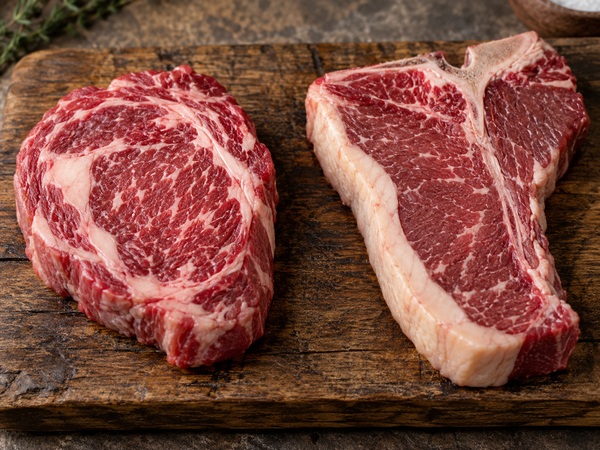
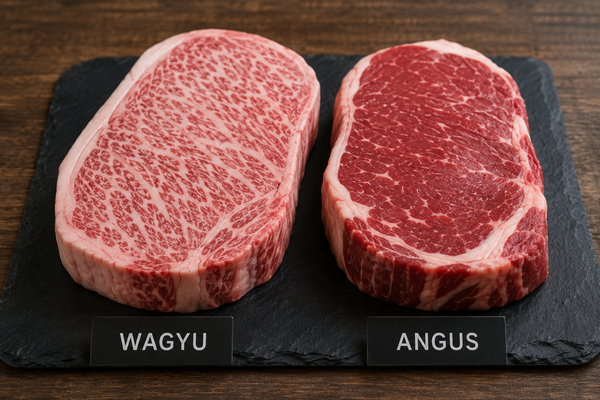
A marble score measures intramuscular fat: the fine white flecks running through the muscle itself, not the fat around the outside of the steak. Graders assess it on the cut face of the rib eye after the carcase is quartered, comparing the pattern against a standard set of reference images.
What matters is distribution as much as quantity. A high score means fat is spread finely and evenly through the eye, like lace, rather than sitting in a few thick seams. That fine dispersal is what melts through the meat as it cooks and gives Wagyu its texture.
Wagyu carries more of it than other cattle because of genetics. The breed deposits fat inside the muscle rather than only around it, and long feeding programs let that fat develop. Grading simply puts a number on the result so you can compare one cut against another before you buy.
How the Australian Marble Score Scale Works

Australia uses the AUS-MEAT marble score, running from MB0 with no visible marbling up to MB9+ for the most heavily marbled beef produced here. Most premium Australian beef sits somewhere between MB2 and MB9+, and the band tells you far more about how a steak eats than the brand name does.
| Marble score | What it looks like | How it eats |
| MB0 to 1 | Little to no visible flecking | Lean, firm, standard supermarket beef |
| MB2 to 3 | Light, scattered flecking | Good everyday steak, clean beef flavour |
| MB4 to 5 | Clear even flecking through the eye | Noticeably richer and juicier, first taste of Wagyu character |
| MB6 to 7 | Dense fine webbing | Pronounced richness, silky texture, smaller portions satisfy |
| MB8 to 9+ | Meat looks almost as white as it does red | Intense, buttery, melts on the palate, best in small servings |
Two cuts carrying the same score can still differ, because the cut itself changes the eating experience. A well-marbled rump will never be as tender as an eye fillet at the same score, which is why cut and score need reading together.
Australian MB vs Japanese BMS vs USDA
Australia grades MB0 to MB9+, Japan grades BMS 1 to 12, and the United States uses Select, Choice and Prime, which is why the same steak can be described three different ways. This is the single biggest source of confusion for Australian buyers, and it explains a question we hear constantly: what is a marble score 12?
| Australian AUS-MEAT | Japanese BMS | Roughly equivalent US grade |
| MB0 to 1 | BMS 1 to 2 | Select |
| MB2 to 3 | BMS 2 to 3 | Choice |
| MB4 to 5 | BMS 4 to 5 | Prime |
| MB6 to 7 | BMS 6 to 7 | Above Prime, Japanese A4 territory |
| MB8 to 9 | BMS 8 to 10 | Japanese A5 territory |
| MB9+ | BMS 10 to 12 | Top of Japanese A5 |
Treat this as a guide rather than a conversion chart, since the systems assess slightly differently. The practical points are these: there is no MB12 on the Australian scale, because ours stops at 9+ and absorbs everything above it. And A5 is not a marble score at all. It is a Japanese grade combining yield (the letter) with quality (the number), where marbling is only one of four quality factors assessed.
What Marble Score Should You Buy?
For most people, MB4 to MB6 is the sweet spot: clearly richer than standard beef, without the intensity that makes a big steak hard to finish. Higher is not automatically better, it is simply richer, and richness has a ceiling that depends on the meal.
| If you want | Buy this band | Why |
| A better weeknight steak | MB2 to 4 | Noticeably above supermarket beef, still an everyday price |
| Your first proper Wagyu | MB4 to 6 | The character is obvious without being overwhelming |
| An occasion steak to share | MB7 to 9+ | Intense and memorable, served in smaller portions |
| Slow cooking or smoking | MB4 to 9+ in brisket | Marbling keeps long-cooked cuts moist, and brisket at high scores stays affordable |
Is MB2+ good? Yes, for what it is. It is a solid everyday steak with clean beef flavour, and it will do a better job on a barbecue with sauces and sides than a heavily marbled cut that gets lost against strong flavours. Save the top bands for when the steak is the centre of the meal.
One thing worth knowing before you shop: cut affects price more than score does. A Wagyu rump at MB8 to 9 sits around $59 per kilogram in our range, while a Wagyu scotch fillet at MB4 to 5 is closer to $109. If you want a high score without the top-band price, change the cut rather than the score.
How Marbling Changes the Way You Cook
The higher the marble score, the gentler and quicker the cooking should be, because that fat begins rendering at a lower temperature than ordinary beef fat. Treat an MB9+ steak like an MB2 and you will render out the very thing you paid for.
Use moderate heat rather than a blazing pan, flip more often, and pull the steak earlier than instinct suggests. Rest it properly, then slice it thinner than a standard steak. Portion sizes shrink as the score climbs: 150 to 200 g of MB8 to 9 satisfies most people, where you might serve 300 g of a leaner cut.
Our guide on how to choose the best Wagyu steak covers breeding and cut selection alongside score, and why MSA grade beef matters explains the separate eating-quality standard you will see on Australian labels.
Where to Buy Wagyu by Marble Score

The simplest way to shop is by band, because it lets you set the eating experience first and choose the cut second. Our range is split exactly that way.
Start with Marble Score 3 to 4 for everyday premium beef, from around $29 per kilogram for brisket up to about $109 for Wagyu scotch fillet. Step up to Marble Score 5 to 6 for a clear lift in richness, with Wagyu steak cuts from around $119 per kilogram. For occasions, Marble Score 7 to 9+ runs from about $59 per kilogram for Wagyu rump to $170 and beyond for the most marbled striploins.
At the very top, our Stone Axe full blood Wagyu sits at MB8 to 9+ from 100% Wagyu genetics, and the wider Australian Wagyu collection carries every band we stock. Every product states its score, so you can compare before you buy rather than guessing from the photograph.
Choose Your Score With Confidence
A marble score is simply a measure of fine fat through the muscle, graded MB0 to MB9+ in Australia. Learn the band that suits your cooking and your budget, and the label stops being marketing language.
Browse our Wagyu by marble score and order graded, cryovac sealed cuts delivered Australia-wide.