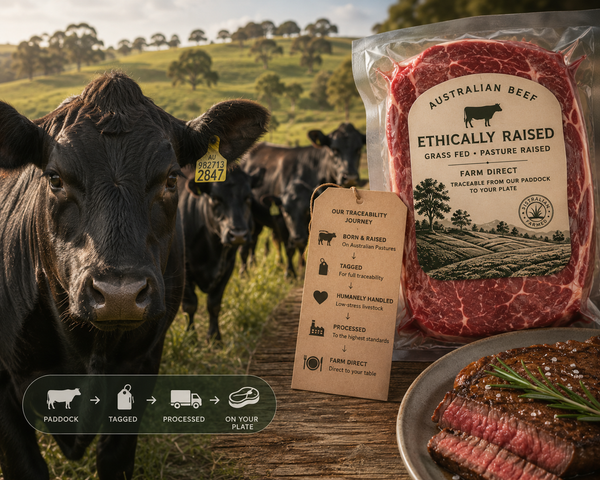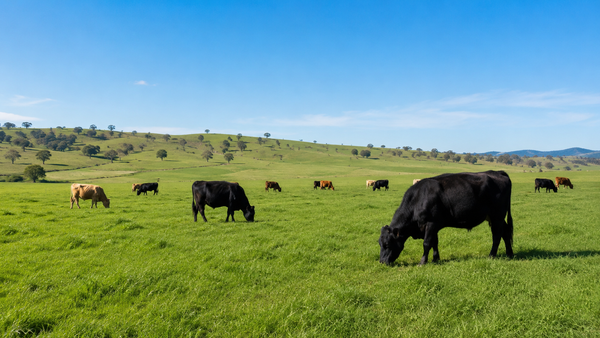

Ethical beef farming in Australia rests on five core practices: strong animal welfare standards, genuine pasture access, careful land stewardship, honest use of hormones and antibiotics, and low-stress handling from paddock to processor.
Australian farmers work under some of the strictest welfare laws in the world, but practices still vary between farms, which is why knowing what to look for matters.
This guide walks through each practice, the certifications that back the claims, and how to buy ethically raised beef with confidence.
What Makes Beef Farming Ethical?
Beef farming is ethical when cattle live low-stress lives with room to graze, the land is left healthier than it was found, and every claim on the label can be verified.
In practice that means three commitments working together. Welfare covers how animals are handled, fed, transported and processed. Environment covers grazing management, soil, water and native vegetation. Transparency covers whether a farm or supplier will show you the evidence behind its claims.
No single practice makes a farm ethical on its own. The farms doing it well treat welfare, land and honesty as one connected system, which is exactly what the practices below add up to.
Animal Welfare on Australian Cattle Farms

Good welfare starts with low-stress stock handling: quiet movement, no unnecessary force, and cattle that are calm around people.
Australian standards require access to feed, clean water and shelter, and ethical farms go beyond the minimum. Cattle graze open pasture rather than confined pens, receive regular health checks, and are handled by people trained to read animal behaviour. Calm cattle are not just an ethical outcome, they produce measurably better beef, since stress before processing damages tenderness and colour.
We covered the wider system in our look at animal welfare in Australia's meat industry, including where standards are strong and where buyers should still ask questions.
Land and Environmental Stewardship
Ethical farms manage grazing so the land improves over time, using rotational grazing to rest paddocks and rebuild soil.
Rotational grazing moves cattle regularly so pasture recovers, roots deepen and soil holds more carbon and water. Many Australian producers now go further into regenerative practice, managing their farms as living ecosystems. Our explainer on what regenerative beef farming involves covers the approach in detail.
Stewardship also means protecting native vegetation, fencing off waterways and reducing reliance on synthetic fertilisers and pesticides. A farm that cares for its country is usually a farm that cares for its cattle; the two disciplines run on the same mindset.
Hormones, Antibiotics and Feed: What Ethical Farms Avoid
Ethical Australian beef farms avoid hormone growth promotants, use antibiotics only to treat illness rather than promote growth, and make honest claims about feed.
Hormone growth promotants (HGPs) are legal in Australia, so HGP-free is a deliberate choice, not a default. Ethical producers make that choice and say so plainly. Antibiotics have a legitimate welfare role in treating sick animals, but routine use as a production tool is the line responsible farms will not cross.
Feed claims deserve the same honesty. Grass fed, grain finished and 100% grass fed and finished mean different things, and an ethical supplier will tell you exactly which applies rather than letting a vague label do the work.
Transport and Processing Standards
Ethics do not stop at the farm gate: responsible transport and calm processing are part of the standard.
Australian regulations set limits on journey times, stocking densities and handling during transport. Meat Standards Australia (MSA) reinforces this commercially, because its grading pathway requires careful handling from paddock to processor. Stressed cattle fail on eating quality, so the system rewards farms and processors that keep animals calm at every step.
This is one of the quiet strengths of the Australian industry: welfare and quality point in the same direction, and the farms raising beef ethically are usually the ones producing the best steaks. It is the same principle behind how Australian farmers raise ethical Wagyu at the premium end of the market.
Certifications That Back the Claims
Certifications turn ethical claims into verifiable standards, and each one guarantees something different.
| Certification or standard | What it actually guarantees |
|---|---|
| RSPCA Approved | Independently audited animal welfare standards covering housing, handling and health |
| MSA (Meat Standards Australia) | Eating quality grading that requires low-stress handling from paddock to processor |
| Certified Organic | No synthetic chemicals, no HGPs, organic feed and land management, independently audited |
| PROOF (Pasture Raised On Open Fields) | Genuine pasture access for the animal's life, audited against pasture-raised standards |
No single logo covers everything, so read them together. For a deeper breakdown of each scheme, see our guide to the certifications that matter when buying ethical meat.
How to Buy Ethically Farmed Beef

The simplest test of an ethical supplier is whether they can name the farms their beef comes from.
Ask five questions before you buy: Where was this beef raised? Was it HGP-free? How was it finished, grass or grain? Which certifications apply? And can you tell me about the farm? A supplier committed to ethical sourcing answers all five without hesitation.
Carnivore Society buys farm-direct from Australian producers we know and have vetted, choosing 100% grass fed and finished beef from farms that meet the standards in this guide. We explain exactly what sets our ethical meat sourcing apart, because transparency is the whole point.
Buy Beef That Meets the Standard
Ethical beef farming in Australia is a system: welfare, land stewardship, honest inputs, calm transport and verifiable claims working together. When you buy from suppliers who can prove all five, better ethics and better beef arrive in the same box.
Explore Carnivore Society's farm-direct, ethically sourced range, delivered Australia-wide.