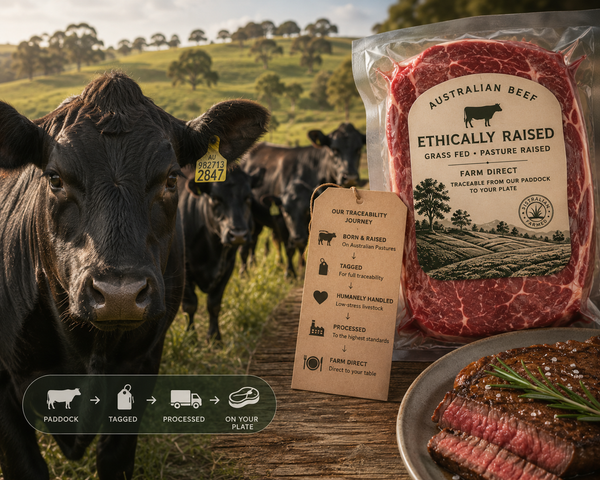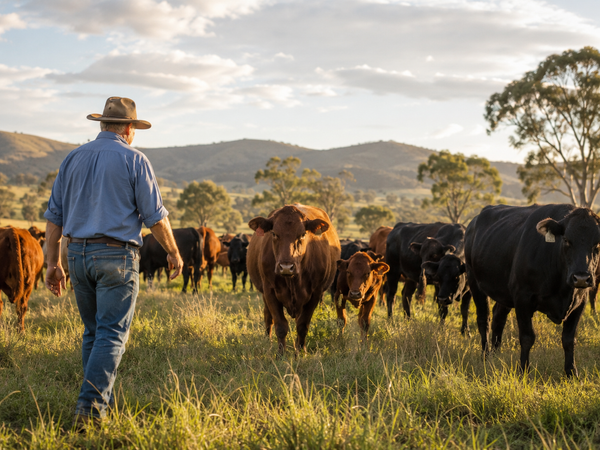

On well-managed Australian pasture, grass finished cattle can be better for the environment, though the full picture deserves an honest look. Grass finished beef sustainability depends on how the land is managed, not just what the animal eats.
The debate is real: grass systems store carbon and use land crops cannot, yet per-kilogram emissions tell a different story.
This guide explains what grass finished actually means, where these cattle genuinely help the planet, where the trade-offs sit, and how to buy genuinely grass fed and finished beef.
What Does Grass Finished Actually Mean?
Grass finished means the animal ate grass and forage for its entire life, right up to processing, with no grain finishing phase. The distinction matters because the terms are often blurred on labels.
Most Australian cattle start life on pasture, so almost any beef can technically claim a grass fed beginning. The difference shows at the end. Grain fed cattle move to a feedlot for their final months, while grass finished cattle stay on pasture from first day to last. If you want the full breakdown of the related labels, our guide to grass fed vs pasture raised beef covers what each term really promises.
When a label says 100% grass fed and finished, the whole life cycle happened on pasture. That single phrase is the one worth looking for.
The Environmental Case for Grass Finished Cattle

The strongest environmental argument for grass finished cattle is that they turn land unsuitable for crops into food while keeping carbon in the ground.
Well-managed pastures act as a carbon sink. Growing grass draws carbon dioxide from the atmosphere and stores it in roots and soil, and grazing done properly stimulates that cycle rather than depleting it. This is the engine behind regenerative beef farming, where rotational grazing is used deliberately to build soil health.
Grass finished systems also sidestep the grain supply chain. No feedlot ration means no cropping, fertiliser or transport footprint attached to feed. The cattle upcycle plants humans cannot eat into high-quality protein, on country that could never grow vegetables or wheat.
The Honest Trade-Off: Emissions per Kilogram
Measured purely per kilogram of beef produced, grass finished cattle can emit more methane than grain fed cattle, because they take longer to reach market weight.
A feedlot animal finishes faster on energy-dense grain, so its lifetime emissions are spread over more meat, more quickly. Research comparing grass and grain finished systems shows the answer flips depending on what you count. Include soil carbon sequestration and land use, and grass systems close the gap or come out ahead. Count only emissions per kilogram, and grain finishing looks leaner.
That is the honest verdict: grass finished is not automatically lower-emission, but on healthy, well-managed pasture the whole-system maths favours it. The quality of grazing management decides the outcome.
Why Australian Grazing Is Different
Australia's climate lets most cattle stay on pasture year-round, which changes the sustainability equation compared with the northern-hemisphere systems most studies measure.
US research assumes long feedlot phases and housed winters. Australian herds graze open country in every season, and a growing number of producers run rotational and regenerative programmes that actively rebuild soil. The link between grazing style and eating quality is real too, as we cover in how regenerative farming improves beef quality.
Producers here are also held to strong land stewardship expectations, from protecting native vegetation to managing water. It is one reason sustainable beef production matters for the future of the whole industry, not just individual farms.
Grass Finished vs Grain Finished: Side by Side
Neither system wins on every measure, so the fairest comparison is factor by factor.
| Factor | Grass finished | Grain finished |
|---|---|---|
| Emissions per kg | Higher, longer time to market weight | Lower, faster finishing |
| Carbon sequestration | Strong on well-managed pasture | Minimal, feed cropping adds footprint |
| Land use | Uses non-arable grazing country | Requires cropland for feed |
| Animal lifestyle | Open pasture for life | Final months in a feedlot |
| Eating quality | Leaner, deeper beef flavour | More marbling, milder flavour |
| Typical price | Higher per kg | Generally lower per kg |
Seen whole, grass finishing rewards the land where management is good, while grain finishing wins on speed and consistency. For premium buyers weighing ethics, flavour and footprint together, well-managed grass finished beef is the stronger choice.
Does Grass Finished Beef Eat Better?
Grass finished beef is typically leaner, with a deeper, more mineral flavour and yellower fat than grain fed beef.
The flavour reflects the pasture. Expect a cleaner, beefier taste with less buttery marbling than a feedlot-finished steak, and a firmer texture that rewards careful cooking. Lower heat and a proper rest bring out its best.
Nutritionally, grass finished beef tends to carry more omega-3 fatty acids and higher levels of nutrients such as vitamin E and beta-carotene, which is what gives the fat its golden tint. For many buyers the environmental case and the eating case point in the same direction.
How to Buy Genuinely Grass Fed and Finished Beef

The only phrase that guarantees no grain finishing is 100% grass fed and finished, so look for it and ask if it is missing.
Grass fed alone can legally describe an animal finished on grain. Check for certification logos, ask where the cattle were raised, and favour suppliers who name their farms and regions. A supplier who knows the answer will happily give it. The same questions help you tell apart free range and grass fed beef, two labels buyers often assume mean the same thing.
Carnivore Society sources 100% grass fed and finished beef directly from trusted Australian farms, so the label on the box matches the life the animal actually lived.
Choose Beef That Rewards the Land
Grass finished cattle are better for the environment when the pasture under them is managed well, even though per-kilogram emissions tell a more complicated story. The land benefits, and so does your plate.
If you want beef that supports healthy soil and honest labels, shop Carnivore Society's 100% grass fed and finished range, delivered Australia-wide.